
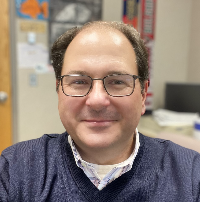
Dr. Paul J. Galardy
Consultant, Division of Pediatric Hematology/Oncology, Department of Pediatrics
Professor of Pediatrics
Assistant Professor of Biochemistry and Molecular Biology
Mayo Clinic, Rochester, Minnesota
It’s Like A Bomb Just Exploded in Their Life and World
** This is a transcript of Dr. Galardy’s presentation at the 2025 Wagons of Hope Fundraiser**
It is pretty shocking to think that in the United States, every year about 10,000 children will be diagnosed and need to undergo treatments for one type of cancer. It sounds like a lot, and it actually is when you think of every one of those children has a family who has been really devastated by the diagnosis. The way I often describe it to families is that a bomb has just exploded in their life and in their world.
I don't think, even though I've watched families go through this, there's really no way that I can understand what that feels like. And so 10,000 times this happens every year. And the number is going up a little bit year after year, not just because the population is expanding, but for reasons that we don't understand, more children are being found to have the cancer.
The treatment of childhood cancer also is a little different than the way it's handled in adults. If you go to most hospitals in the community, smaller towns and cities across the upper Midwest, many of those hospitals have cancer centers, and those cancer centers are really vital for the treatment of cancers in adults. And so most adults, I think, live within probably an hour or so of a facility that might be able to help them.
But for children, it's very different. The physicians and the nurses and nurse practitioners and infrastructure needed to treat a childhood cancer is more unique and really is clustered in large academic medical centers like Mayo Clinic. And so I was trying to think, in the entire upper Midwest, how many hospitals there might be that can do this, and it's somewhere maybe around 6 to 10, if you think of all the Dakotas and Minnesota and Wisconsin, and even if you head over to Iowa, and maybe even if you consider Illinois, just there aren't that many hospitals that can do this.
And so what that means is that families, the vast majority of families, are not going to be living near a hospital that can provide the care that these children need. My other observation over time has been that the care that we provide to these children has become more and more complex year after year. If I look back to when I started taking care of children at Mayo Clinic until now, there have been entirely new modalities invented to treat children with cancer.
One that I think gets a lot of press is, of course, the proton beam radiation center that Mayo has built, and that's one example, but there are many others. And so that has even more so clustered the care of children, because now if you think about those maybe 10 hospitals that I outlined that can treat children with cancer, maybe only a handful or less actually can do these more cutting-edge, new modalities of treatment. And so all this high specialization means that families need to drive even further than it was 17, 18 years ago when the Erickson’s [boy Silas was treated for cancer].
And so this makes it even more vital that there are support systems in cities like Rochester where we see a lot of children who come to Mayo Clinic with cancer and may need other very high technology care, like organ transplants, heart transplants, liver transplants, kidney transplants, who have very unique healthcare needs. And so people are coming from very great distances, and it's not feasible to come three, four times a week for appointments from five, six, ten hours away. We need to have a support system in place here for these many families.
There has been an improvement in the support systems in Rochester, I would say, over the last two decades, but many of the children, particularly in the area that we see in cancer and in those patients who go through organ transplantation, have even a little bit more specialized needs than, I'd say, some of the other families who might be coming to Rochester for the highly specialized care that Mayo can provide. The treatment for childhood cancer is quite hard, not just on the families, but on the child. Those children often are very susceptible to infection.
And it's most ideal for those children to have a little bit of extra space where they're not necessarily around lots of other children and families. Particularly in the wintertime, we know that there are lots of infections going around. …There is a desperate need for facilities like Cy's Place to help support the children and families who are making this really difficult journey to bring their children here for the specialized care that Mayo can provide.
So, I think, just to wrap up, I want to again congratulate the Ericksons for the hard work they've done providing support to families and children in this community over the last many years. And to thank everyone who [has been supporting] them in this mission, and I really hope to be able to see the Ericksons realize their goal of building their new facilities so that children and families can try to feel a little bit more like home while they're very far away from home. Thank you so much.